Jensen Huang’s Taiwanese Appeal Sparks Discussion: NFU Invites Poet Hsiang Yang to Speak on How Native Languages Empower Global Engagement
2026-06-02
Admin System
Recently, during his visit to Taiwan, global AI industry leader Jensen Huang frequently interacted with the public in fluent Taiwanese, attracting significant media attention and once again highlighting the cultural identity and emotional connections embodied in native languages. In an era of rapid globalization and artificial intelligence development, understanding one’s own culture and preserving the memories of the land have become increasingly important educational issues. On June 2, National Formosa University (NFU) hosted the “Voice of Formosa: Native Language Masters Lecture Series,” inviting Hsiang Yang, one of the most influential figures in modern Taiwanese poetry, to deliver a lecture titled “Poetic Songs Written for the Land: On Writing Taiwanese Poetry and Song Lyrics.” Through literature, music, and personal life experiences, he guided faculty members and students in rediscovering the cultural value of the Taiwanese language. The event also featured a Taiwanese-language readers’ theater performance by students from NFU’s Five-Year Junior College Division, showcasing the learning outcomes of the university’s Taiwanese Performing Arts course. Hsiang Yang, whose real name is Chi-Yang Lin, is a pioneering figure in modern Taiwanese poetry. He is widely recognized as a poet, writer, cultural critic, and veteran media professional. Throughout his distinguished career, he has received numerous honors, including the National Award for Arts, the Wu Cho-liu New Poetry Award, recognition as an Honorary Writer at the University of Iowa, the Golden Melody Award for Best Traditional Arts Lyricist, and the Ministry of Education’s Outstanding Contribution Award for the Promotion of Native Languages. During his lecture, Hsiang Yang reflected on his personal background and literary journey. Born in Lugu Township, Nantou County, he grew up in a family that operated a Dong Ding tea business while also selling books and stationery, immersing him in a rich reading environment from an early age. His exposure to classical novels, translated literature, and modern poetry gradually inspired his path toward literary creation. During his university years, he began contemplating what a distinctly Taiwanese literary expression might look like and chose to devote himself to ten-line poetry and Taiwanese-language poetry, forging a unique literary path amid the dominance of modernist poetry and Mandarin-language policies. Hsiang Yang noted that in Taiwan during the 1970s, most modern poets did not write in Taiwanese. At the time, Taiwanese was often regarded as a “non-standard” language, and Taiwanese television dramas and songs were frequently stereotyped as lowbrow culture. This social climate prompted him to reflect on whether he had a responsibility to address the marginalization of his mother tongue within literature. He explained that while he could write excellent poetry in Mandarin, he felt incomplete if he could not create in his own native language. “The language on my tongue—my mother tongue—is my unique identity,” he remarked. For him, Taiwanese poetry became a meaningful way to connect with the land, history, and his own sense of self. Over the years, many of his works—including “Father’s Lunch Box,” “Mother’s Hair Bun,” “When the World Falls Silent,” “The Autumn Wind Cannot Read My Longing,” and “Tongue-Biting Poetry”—have been adapted into songs and widely performed. Through music, his poetry has moved beyond the pages of books and entered public life, enabling native-language literature to transcend generations and continue flourishing. The event also featured a Taiwanese-language readers’ theater performance titled “Three Baozhengs, Eighty Jin,” presented by students from NFU’s Five-Year Junior College Division. Based on the historical experiences of Taiwanese sugarcane farmers during the Japanese colonial era, the production portrayed the hardships faced by ordinary people and agricultural workers under exploitation by sugar corporations. By interpreting historical narratives through their mother tongue, students not only demonstrated their learning achievements but also echoed the lecture’s central themes of preserving local memory and honoring the lives of ordinary people. NFU President Hsin-Liang Chang remarked that the widespread discussion sparked by Jensen Huang’s natural use of Taiwanese serves as an important reminder: truly internationally competitive talent is not defined solely by technological expertise and professional knowledge, but also by an understanding of one’s cultural roots and local heritage. Native languages are more than communication tools—they are vital carriers of cultural memory and identity. President Chang further noted that since 2023, NFU has continuously organized the “Voice of Formosa: Native Language Masters Lecture Series,” which has become one of the university’s signature humanities programs. Beyond conventional language instruction, the university integrates literary lectures, Taiwanese-language readers’ theater, performance arts, and interdisciplinary cultural activities to help students experience the vitality of native languages firsthand and gain a deeper understanding of their significance in literature, music, history, and public culture. President Chang emphasized that in an era when AI is rapidly transforming the world, education must cultivate not only technological competence but also cultural understanding and social awareness. As a university of science and technology, NFU has long been committed to promoting native language education and cultural preservation. The university hopes to nurture a new generation of talent equipped with professional expertise, global perspectives, and cultural confidence, enabling students to engage with the world while remaining firmly connected to their roots.
Information provided by: Language Teaching and Development Center
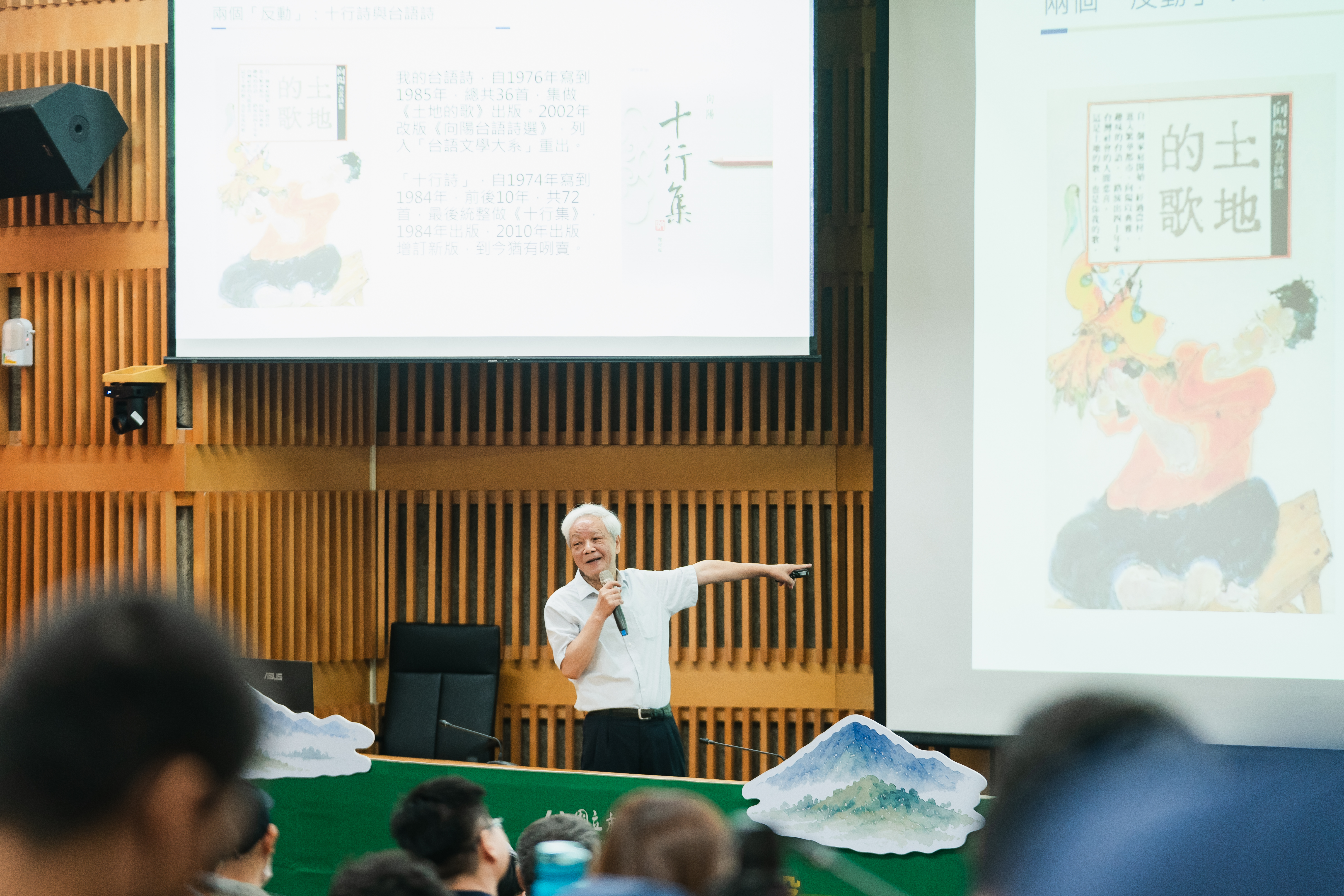
NFU’s “Voice of Formosa: Native Language Masters Lecture Series” invited Hsiang Yang, a leading figure in modern Taiwanese poetry, to deliver a special lecture on campus.
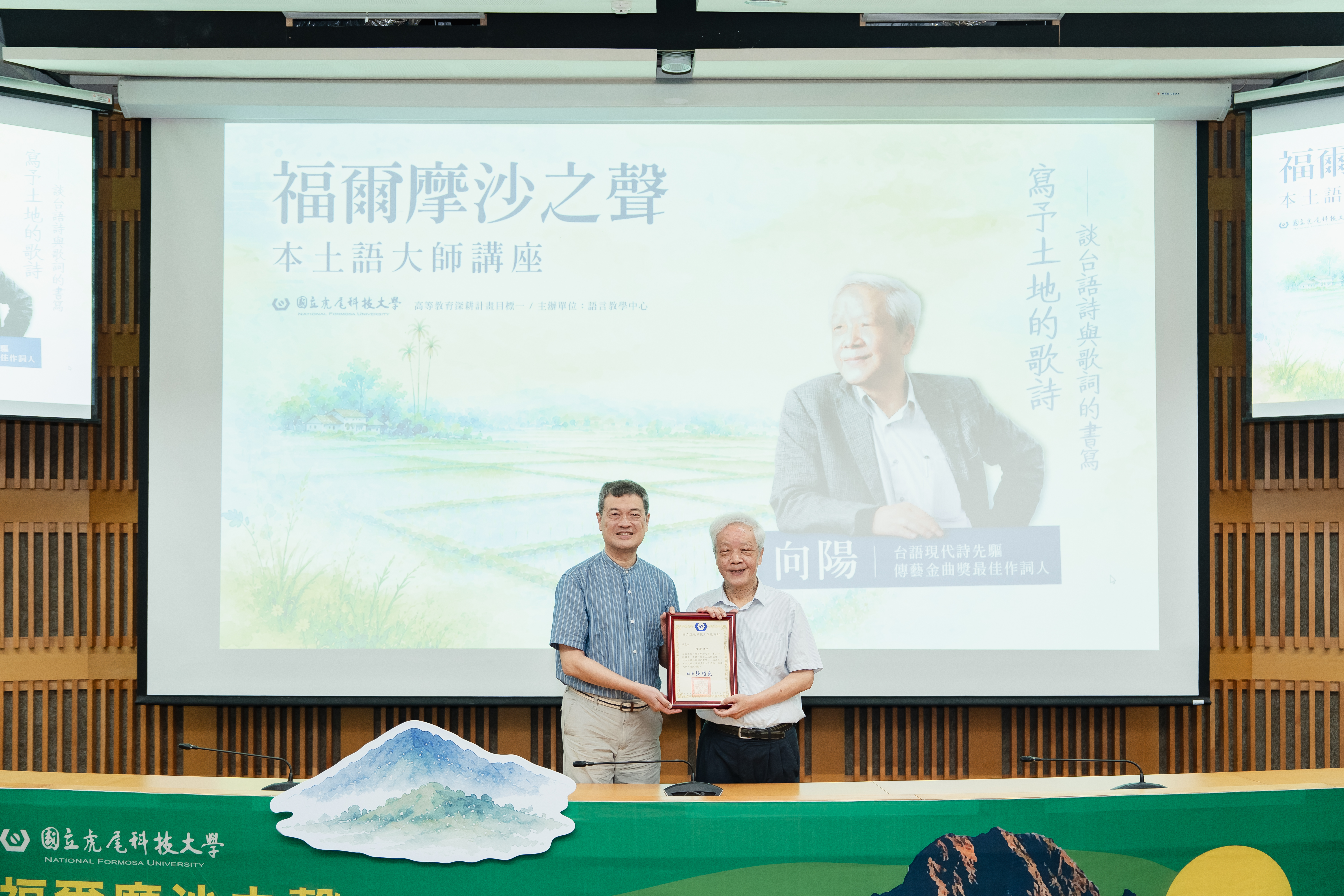
Pioneer of modern Taiwanese poetry Hsiang Yang (right) shared insights into the cultural value of the Taiwanese language. A certificate of appreciation was presented by Chung Cheng-Ta (left), Director of NFU’s Language Teaching and Development Center.
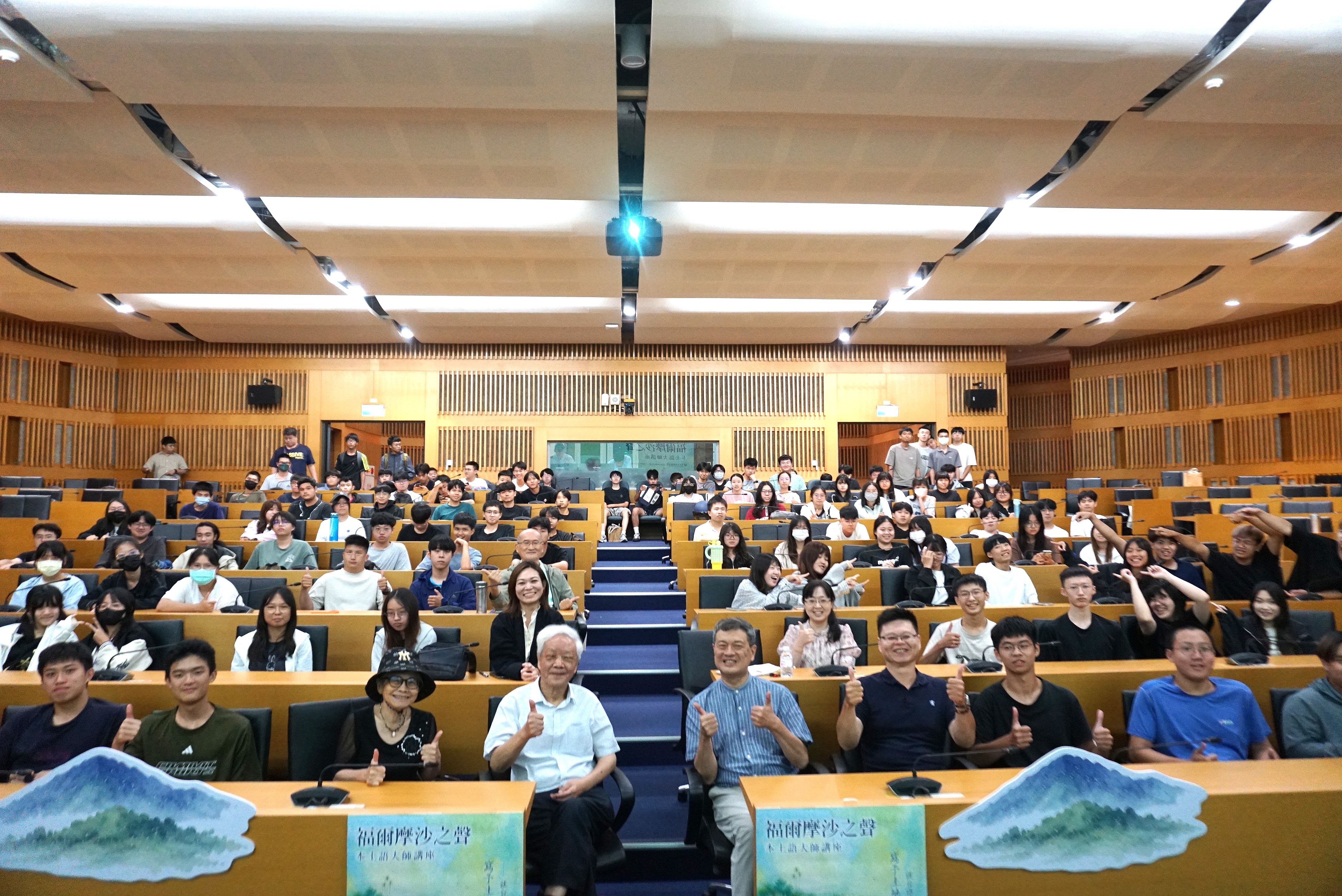
NFU invited Hsiang Yang, a pioneer of modern Taiwanese poetry, to guide faculty members and students in rediscovering the cultural significance of Taiwanese through literature, music, and lived experiences.
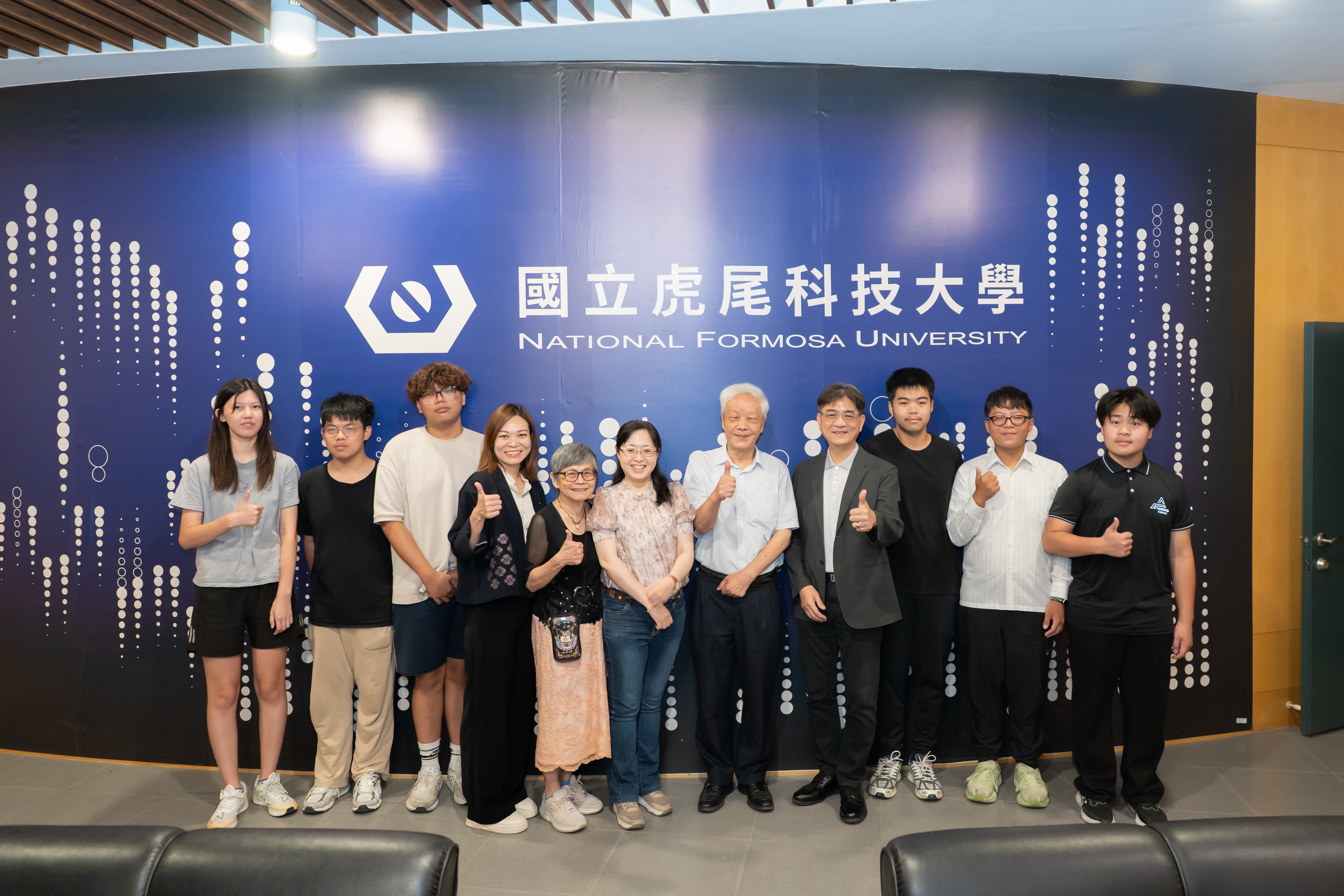
NFU Vice President Da-Jeng Chen (fourth from right), Assistant Professor Yi-Pin Chang (fourth from left), and Assistant Professor Yi-Chun Chen (sixth from left) from the Language Teaching and Development Center led students from the Five-Year Junior College Division in a Taiwanese-language readers’ theater performance to welcome Hsiang Yang (fifth from right) and Ministry of Education Native Language Promotion Committee member Jui-Hsia Lin (fifth from left).