
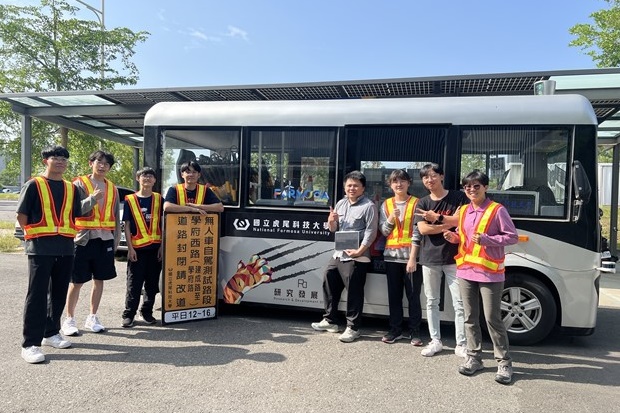
National Formosa University is committed to cultivating talent with practical skills and cross-disciplinary integration capabilities, achieving outstanding results particularly in self-driving vehicle research and innovation. Since December of last year, NFU's self-driving vehicle team has obtained road rights for testing in the area surrounding the Yunlin High Speed Rail Station, accumulating more than 30 kilometers of test mileage while complying with regulatory requirements, gradually building the technical foundation needed for autonomous vehicles to operate on public roads.
●Realizing a Blueprint for Smart Mobility
NFU's self-driving vehicle subsystem technology is independently developed through the integration of cross-disciplinary mechatronics teams within the university, spanning 6 major fields: positioning and navigation, sensor fusion, image recognition, decision and control, human-machine interface, and vehicle-to-everything (V2X) integration applications, working toward the goal of real-world road operation and shuttle service between stations.
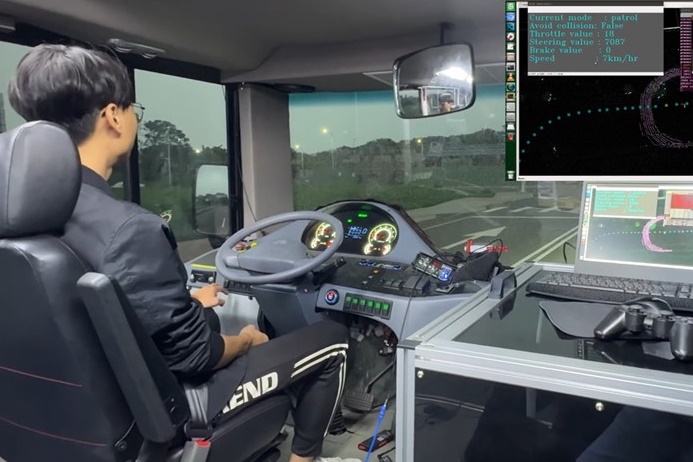
Among the technology's highlights, in addition to system integration, real-time control, and virtual-physical validation, the team has also pursued a comprehensive strategic layout, integrating the Robot Operating System (ROS) with the vehicle's CANbus communication network across platforms, providing real-time feedback for environmental sensing and control commands. Using an intuitive graphical user interface (GUI) developed in-house, the university has built an "Electric Bus Command Center," enabling real-time monitoring of vehicle status while improving operational convenience, facilitating data collection and accurate analysis.
To accelerate development and reduce testing risks, the university has further built a "Digital Twin Virtual-Physical Integrated Testing Environment," creating digital twins of both the self-driving vehicles and the road environment, receiving real vehicle and sensor data to simulate various traffic scenarios in a virtual environment, training and validating the responses of the self-driving vehicle's subsystems, making the algorithm development, validation, and tuning cycle shorter, safer, and more efficient.
●Leveraging Generative Design
In terms of materials application, NFU has applied advanced aerospace composite material technology to the development of vehicle body structures, reducing vehicle body weight while enhancing battery protection, successfully reducing the weight of the large electric bus's body frame and skin by 65%, significantly improving both driving range and safety.
In the era of electric vehicle adoption, many components differ from those used in traditional gasoline-powered vehicles, requiring entirely new designs or partial modifications to fit with existing parts. NFU applies AI-driven Generative Design to provide industry-academia R&D services for electric vehicle design and testing, partnering with well-known domestic vehicle component manufacturers to advance smart manufacturing implementation on production lines, working toward a fully realized vision of comprehensive smart production.
NFU plans to pursue self-driving vehicle licensing in the second half of this year, and in the coming year, plans to apply for the Ministry of Economic Affairs' "Unmanned Vehicle Technology Innovation Regulatory Sandbox Program," accelerating the practical application of its self-driving vehicle R&D achievements and helping to drive momentum for related industry development.
Reprinted from: United Daily News
 |
 |
|
NFU's self-driving vehicle team has pursued a comprehensive strategic layout — from system integration and real-time control to virtual-physical validation — achieving outstanding results. |
The self-driving vehicle team obtains road rights for testing in the area surrounding the Yunlin High Speed Rail Station. |