
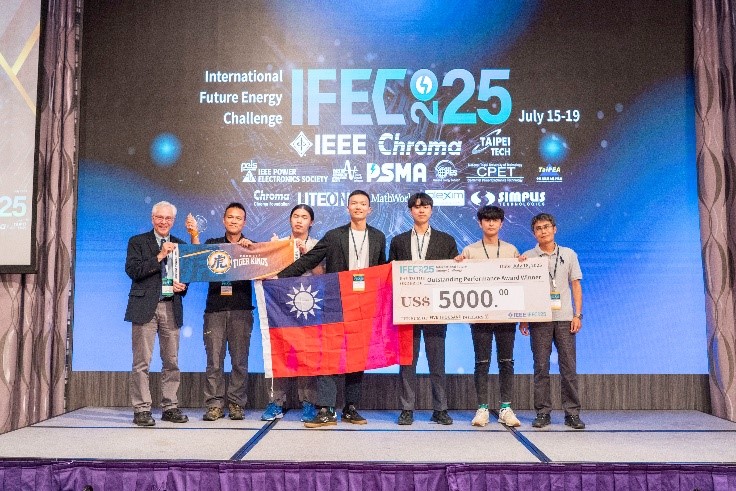
The 2025 International Future Energy Challenge (IEEE IFEC 2025) was hosted by Taiwan, with the finals held from 7/15 to 7/18 at the headquarters of Chroma ATE Inc. A faculty-student team from National Formosa University's Department of Vehicle Engineering, led by Professor Wang Chien-Min, delivered an outstanding performance, standing out among 17 teams from 10 countries including the United States, Germany, and South Korea, to win 2nd place worldwide along with a $5,000 cash prize — bringing further international honor to Taiwan!
This year's competition was led by the Institute of Electrical and Electronics Engineers (IEEE) and its affiliated professional organizations, including the Power Electronics Society (PELS), the Industry Applications Society (IAS), the Power & Energy Society (PES), and the Power Sources Manufacturers Association (PSMA). This year's competition theme was "Isolated DC-DC Converters with Fast Transient Response and Low Noise," and the competition — spanning preliminary, semi-final, and final rounds — took a full year to complete.
In the preliminary round, an international panel of professional judges conducted a written review. Selected teams then traveled to Atlanta, USA, to give oral presentations and answer questions at the Applied Power Electronics Conference (APEC). Teams advancing to the finals were required to demonstrate the actual performance of their products and undergo comprehensive scoring by an on-site panel of professional judges.
This year's competition attracted fierce competition from internationally renowned institutions, including Warsaw University of Technology in Poland, Reutlingen University in Germany, and both KU Leuven and Hasselt University in Belgium. NFU's team was jointly supervised by Professor Wang Chien-Min of the Department of Vehicle Engineering and Associate Professor Wu Sen-Tung of the Department of Electrical Engineering (currently affiliated with the Graduate Institute of Energy Engineering at National Taiwan University of Science and Technology). Student members included Kao Yi-Ting, Liu Yu-Chun, Chen Yu, Shen Yu-Tang, and Li Po-Hung.
Professor Wang Chien-Min of the Department of Vehicle Engineering stated that the adjustable-voltage isolated DC-DC converter designed for this competition had to simultaneously meet the strict requirements of fast transient response and low noise, making it a highly challenging design task. In addition, the competition also required high power density and high efficiency, and incorporated safety-related tests such as a 60-degree constant-temperature test and a lightning surge test, along with a requirement to pass inspection using Chroma ATE's Automatic Test Equipment (ATE) — a test that NFU's team was the only team to successfully complete.
Team leader Kao Yi-Ting shared that the preparation process was extremely challenging, having to juggle coursework and their capstone project while carrying the pressure of representing their country in the competition, often leaving them overwhelmed. However, with careful guidance from their instructors and senior classmates, the team was able to quickly learn and solve problems through hands-on practice. He noted that stepping onto the international stage for the first time and witnessing the sophisticated circuit designs and outstanding presentations from other countries inspired the team to push even harder, ultimately winning 2nd place in the world through stable circuit performance.
Team member Liu Yu-Chun added that over the past year, the team invested tremendous time and effort — from theoretical analysis and simulation data to actual testing. Although they hit a bottleneck with transient response, they ultimately adopted a strategy focused on stability and low noise, becoming the team with the most stable communication performance in the finals. She thanked her instructors and teammates for their hard work, saying this experience will become an important source of growth for her future.
Team member Shen Yu-Tang shared that, as a student in the Department of Vehicle Engineering, entering the field of power supply design felt like starting almost from scratch, and he often questioned whether he had chosen the wrong path. But it was precisely this unfamiliarity that fueled his motivation to learn. Each failure and every late night of continuous effort only strengthened his resolve. He noted that standing on the IFEC finals stage was not just recognition of the team's ranking, but also affirmation of his own courage in stepping outside his comfort zone and persevering through hard work.
NFU's Department of Vehicle Engineering faculty-student team also extended special thanks to the Ministry of Education, the university, and sponsoring companies such as FSP Technology, ON Semiconductor, Taisheng Energy, and Hongyuan Technology, for their support in enabling students to participate and broaden their international horizons. This competition was not only a battle of technical skill, but also a practice in self-challenge and team spirit.
Article provided by: Department of Vehicle Engineering
 |
 |
|
NFU's Department of Vehicle Engineering team represents Taiwan in the competition, winning 2nd place at the International Future Energy Challenge. |
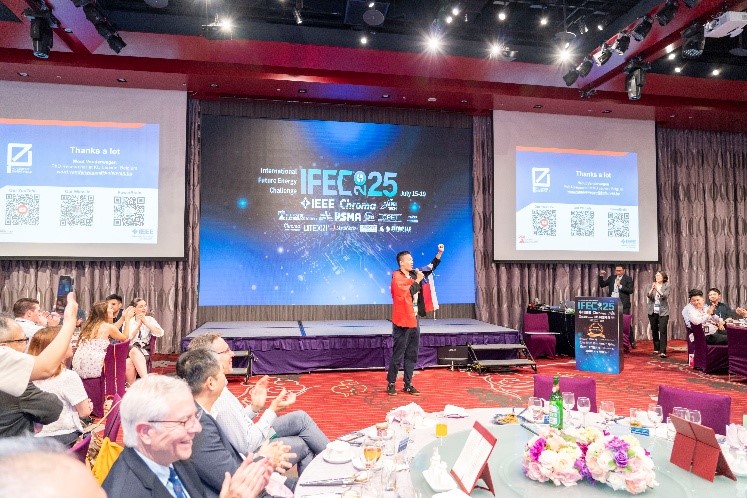
A representative of NFU's award-winning Department of Vehicle Engineering team delivers an acceptance speech. |
 |
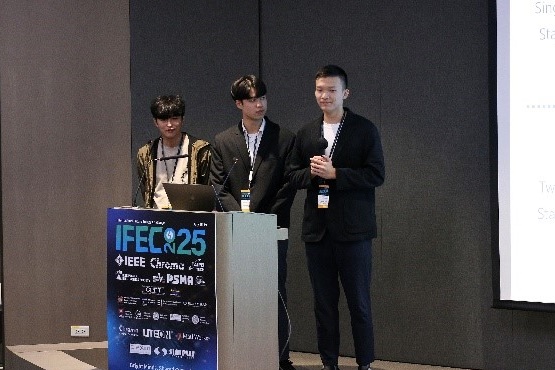 |
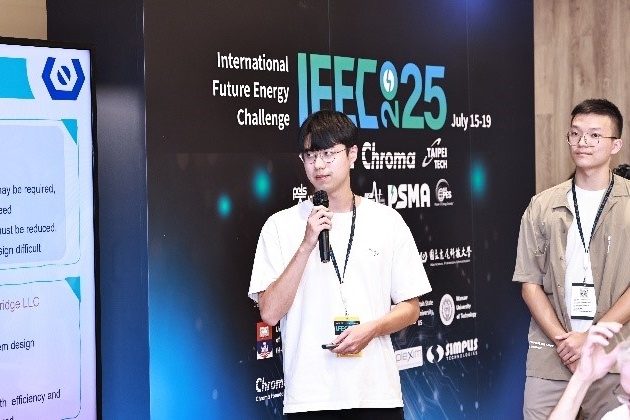
| NFU's Department of Vehicle Engineering team presents their project at the international competition venue. | |